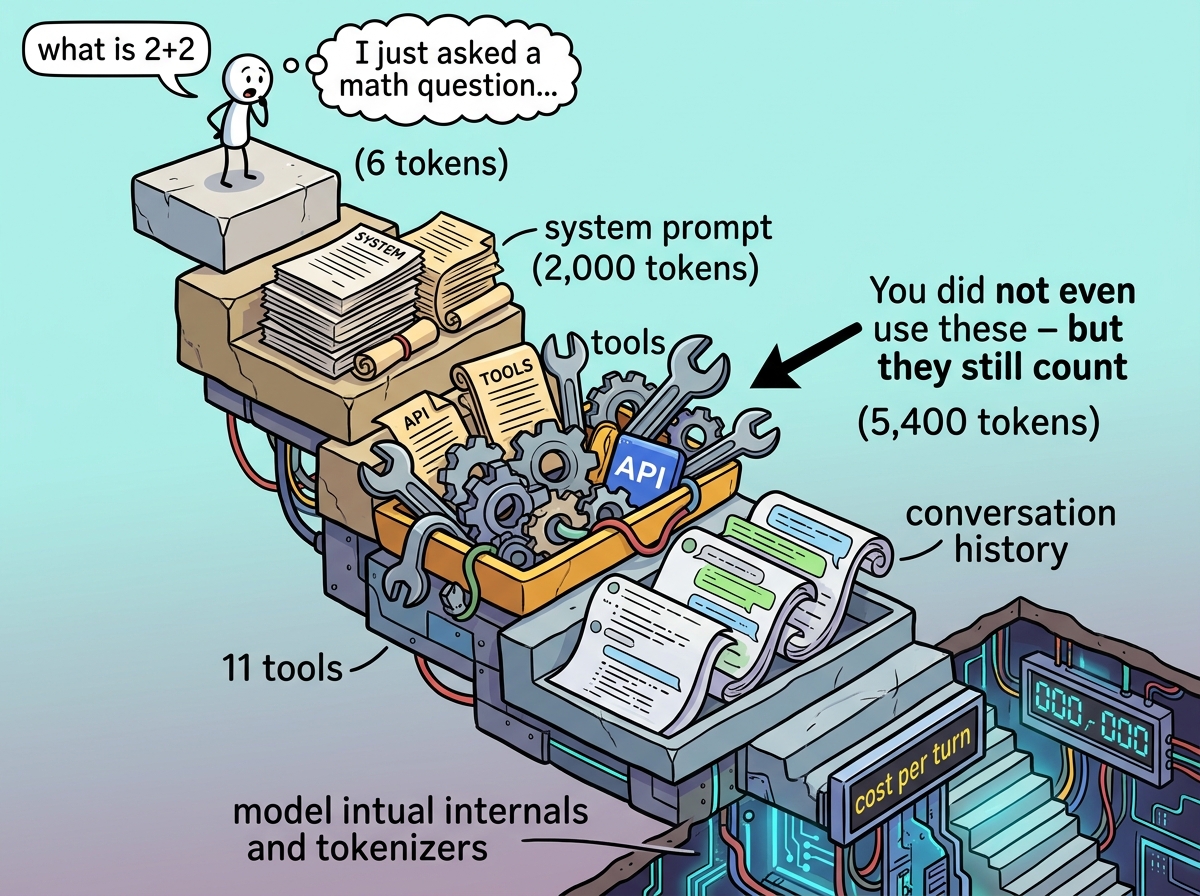
“Context is a staircase. Your prompt is merely the top step—the platform built the rest beneath your feet.”
You fire up your terminal, open your favorite AI coding assistant, and type an innocent, lightning-fast question:
"what is 2 + 2?"In your mental accounting, this is a clean six-token transaction. The inference should return in ten milliseconds and cost an invisible fraction of a penny.
Then you inspect your OpenTelemetry collector, your cloud provider’s API dashboard, or your local gateway traces. The telemetry slaps you across the face:
Input Tokens: 7,542. Output Tokens: 1. Time to First Token (TTFT): 1.4 seconds.
Before the model even considered generating the number four, it evaluated seven and a half thousand tokens of architectural baggage.
Welcome to the hidden staircase of context.
⚡ Executive Summary: A 6-token user query frequently carries >7,500 tokens of hidden overhead from static system prompts and dormant MCP tool schemas. Flattening this staircase via on-demand tool loading and schema pruning slashes baseline token consumption by up to 85%.
Jump to Staff+ STAR Breakdown ↓Anatomy of the Staircase
When developers interact with modern LLM tooling—especially autonomous coding agents, Model Context Protocol (MCP) servers, and IDE copilots—they only perceive the polished top step.
Beneath the surface rests a towering pyramid of accumulated state shipped across the wire on every single request:
[ Step 1: User Prompt ]         --> "what is 2 + 2?" (~6 tokens)
        |
[ Step 2: System Instructions ] --> Personas, constraints, repo rules (~1,800 tokens)
        |
[ Step 3: Tool Schemas (MCP) ]  --> 11 JSON schemas for bash, git, fs, etc. (~5,400 tokens)
        |
[ Step 4: Turn History ]        --> Past messages, tool calls, and diffs (~200 - 30,000+ tokens)
        |
=============================================================================
[ Subterranean Bedrock ]        --> KV Caches, Attention Matrices, TTFT & Billing
Let’s dissect each tier of the staircase:
1. The Top Step: Your Actual Prompt (~6 tokens)
🗨️ "what is 2 + 2?"
Clean, razor-sharp, and minimal. This is what the user assumes they are paying for.
2. The Second Step: System Prompts & Guardrails (~1,800–2,000 tokens)
📝 “You are a senior principal engineer with deep expertise in…”
This layer injects behavioral instructions, safety guardrails, XML output constraints, workspace paths, and formatting requirements. Even if you only asked for elementary school arithmetic, the model must be reminded who it is, how it should speak, and what safety boundaries it cannot cross.
3. The Colossal Middle Step: Tool Definitions (~5,400 tokens)
🧰 11 Registered Tools, JSON Schemas, CLI Flags & Argument Types
Here lies the most insidious token explosion in autonomous engineering.
To equip an agent with the capability to search the filesystem, execute bash commands, query PostgreSQL, or fetch HTTP endpoints, the runtime serializes the complete JSON Schema definition of every single tool into the request payload.
The brutal reality: You did not invoke a single tool to add two plus two. Yet, every schema for every inactive tool was serialized, transmitted, tokenized, and billed on that prompt.
4. The Fourth Step: History & Turn Debt (~200 to 50,000+ tokens)
💬 Prior turns, system notifications, tool execution logs, and contextual summaries.
In multi-turn conversations, this step balloons exponentially. Every line of compiler output, every git diff summary, and every file read persists in the context window until the session terminates or context pruning kicks in.
5. The Bedrock: The Attention Matrix & Infrastructure Cost
⚙️ Attention mechanisms, KV-caching limits, VRAM allocation, and TTFT
In transformers, self-attention scales quadratically with sequence length ($O(N^2)$), and prefill computation dominates latency. A 7,500-token prompt creates real thermodynamic heat in a data center, saturates memory bandwidth, and spikes Time to First Token.
The MCP Tax: How Tool Hoarding Kills Token Economics
As the industry embraces modular tool standards like MCP (Model Context Protocol) and custom agent plugins, we have walked into a classic distributed systems trap:
Every capability you grant an agent makes it marginally smarter, but permanently makes every future question slower and more expensive.
Consider the math of a typical developer workstation running an agent with 15 MCP tools:
- Average schema size per tool: 350–500 tokens
- Total static tool overhead: ~6,000 tokens per call
- Workday interaction volume: 100 turns
100 turns × 6,000 static tool tokens = 600,000 tokens/day in pure baseline waste.Over a month of 20 working days, a single developer burns 12,000,000 input tokens strictly reminding the model how to format arguments for tools that were never called.
If your team runs 25 engineers, that is 300 million tokens every month tossed straight into the architectural incinerator.
This violates two foundational Engineering North Stars:
- [VIII. Cost Efficiency]: Paying for unutilized capability on every round-trip is architectural negligence.
- [IX. Simplicity Over Abstraction]: Packing speculative tools into a monolithic prompt violates zero-trust simplicity.
Architectural Remedies: How to Flatten the Staircase
We do not need to abandon autonomous agents or tool use. What we need is rigorous context engineering:
1. Dynamic Tool Loading (Skills-on-Demand)
Stop dumping twenty tools into the root system prompt. Instead, provide the agent with a single meta-discovery tool (or skill registry). The agent queries the registry only when a task demands specialized capability, loading the heavy schema dynamically into that specific turn.
2. Aggressive Schema Pruning
Most generated JSON schemas are laden with redundant fluff—verbose docstrings, duplicated type annotations, and verbose parameter descriptions. Pruning schemas down to strict minimal signatures can reduce tool overhead by 50–70% without degrading function-calling accuracy.
3. Session Boundary Discipline
Treat AI agent sessions like ephemeral processes, not long-lived stateful servers. When transitioning between distinct tasks (e.g. from investigating a bug to writing tests), terminate the session. Do not drag 40 turns of dead context up the staircase.
4. Two-Tiered Model Routing (System 1 vs System 2)
Not every prompt requires a 200B parameter frontier reasoning model with an agent harness. Route deterministic queries, quick classifications, and simple calculations to compact local models, specialized non-generative classification engines, or rule-based CLI tools that execute with zero prompt overhead.
Conclusion
The next time your AI assistant pauses for a second before answering a basic question, look down into the stairwell.
You aren’t just sending a six-token prompt across the internet. You are standing atop a monolithic tower of instructions, schemas, and historical debt.
The question every Staff+ engineer must ask is: How many unnecessary steps are you carrying up the stairs?
— Andreas, Staff Architect
