Comic strip transcript — Panel 1 (Month 0 — The Dive): A cheerful contractor boards a yellow research submarine labeled "Consultant", sealing the hatch and diving into dark murky water labeled "Customer Abyss & Bespoke Toolchains". Contractor: "See you in 6 months! Entering proprietary SVN builds, Ant scripts, and internal frameworks from 2011!" Panel 2 (Month 3 — The Crystal Ball at Crush Depth): At 5,000 meters depth, surrounded by anglerfish labeled "Legacy Jira Tickets". In the dim submarine cabin, the developer frantically rubs a glowing crystal ball: "I need to study what gets me my next contract! The crystal ball says... two-way data binding and AngularJS $scope directives will make me invincible!" Panel 3 (Month 5 — Periscope Depth): Submarine ascends. Periscope breaches the waves. Crosshairs target LinkedIn, GitHub, and recruiter inboxes. Red klaxon: "CONTRACT EXPIRES IN 14 DAYS." Panel 4 (Month 6 — The Resurfacing Shock): The contractor pops open the submarine hatch in blinding sunshine holding an "AngularJS Guru" sign. On the dock, modern developers sipping flat whites on hoverboards laugh: "Angular?! Bro, everyone moved to React hooks, and today we just orchestrate AI coding squads!" Kurt the Staff+ Engineer: "Welcome back to the atmosphere, Captain Nemo. Your stack deprecated 3,000 meters ago."
--- ## Phase 1: Crush Depth & The Oxygen Problem In the opening weeks of a deep dive, survival takes precedence over philosophy. You learn that running the integration suite requires setting five undocumented environment variables and sacrificing a warm croissant to an oracle server under someone's desk. You learn not to touch the directory labeled `do_not_touch_final_v2/`. You adapt to the pressure. At 4,000 meters depth, surrounded by bioluminescent anglerfish labeled *"Sev-2: NullPointerException in BillingBatch_1998"*, you become fluent in the client's internal dialect. You speak of acronyms that do not exist outside this single corporate VPN subnet. Then, around Month 3, the cold dread creeps in. You look at your terminal. You realize that your entire cognitive capacity is currently consumed by: 1. Debugging a custom XML configuration parser written in Java 6. 2. Waiting for a 47-minute Maven build to compile 14 redundant JARs. 3. Writing boilerplate that violates every tenet of [[IX. Simplicity Over Abstraction]](/north-stars/). The panic hits you: *“My contract expires in 90 days. If I stay down here any longer without surfacing, my market value will be approximately equivalent to a certified Novell NetWare administrator.”* --- ## Phase 2: The Midnight Crystal Ball Every submerged developer eventually attempts to see into the future. At night, after 8 hours of wrangling the client's custom database stored procedures, you sit in the glow of your personal laptop with an uncalibrated fortune-teller’s crystal ball. You ask the eternal contractor question: > *"What technology must I study right now so that when I break the surface, companies will want to hire me?"* 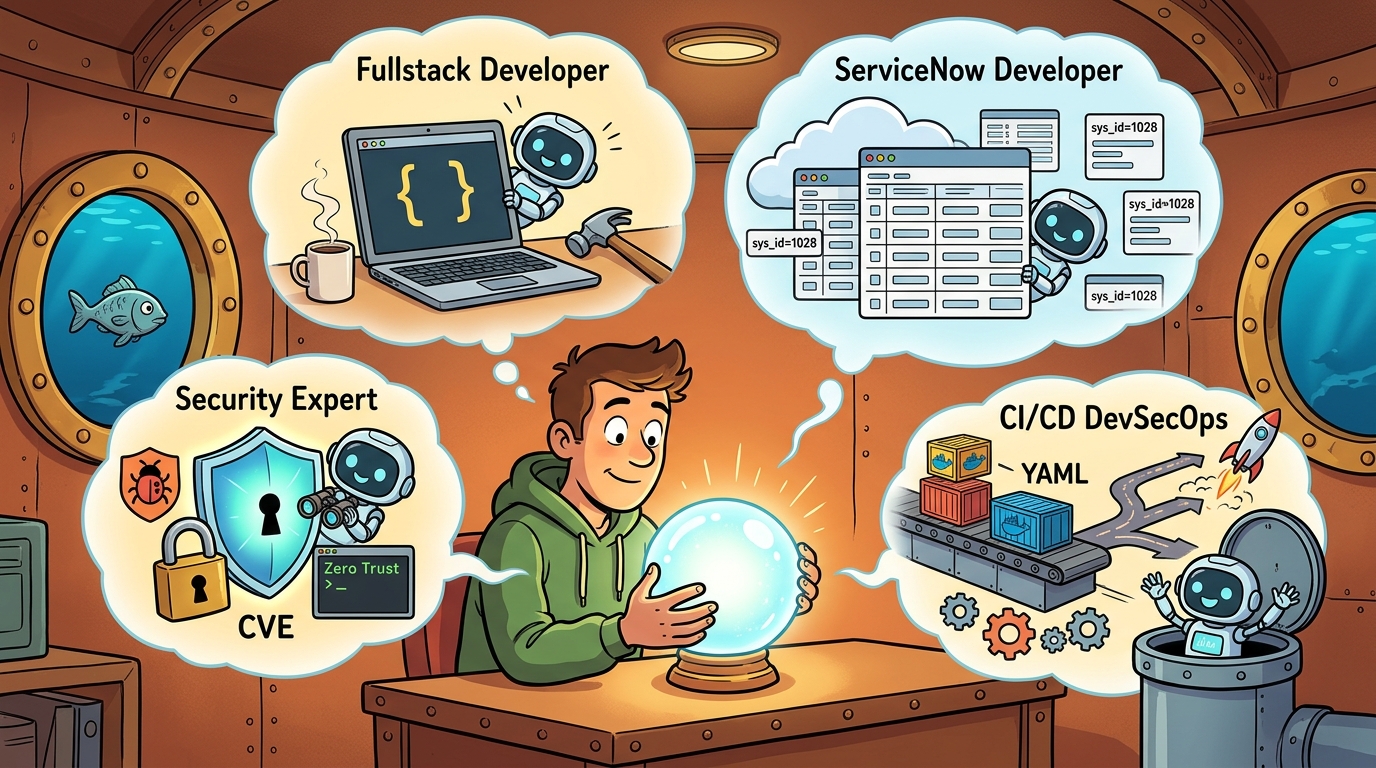Illustration transcript — In a dim submarine workstation, a developer in a grey hoodie leans over a glowing crystal ball. Floating around the ball are four tempting career escape routes: 1. Fullstack Developer: A screen of code and coffee, where a friendly little AI robot peeks over the monitor with an eager grin. 2. ServiceNow Developer: A SaaS cloud stacked with endless forms, XML schemas, and sys_id records ('Everything is a Record!'), where the AI robot pops out from behind a table header. 3. Security Expert: High-tech cyber shields, padlocks, and zero-trust dashboards, with the AI robot peeking out from behind an encrypted vault door holding a magnifying glass. 4. CI/CD DevSecOps: A conveyor belt of YAML pipeline blocks, Docker containers, and release gates, where the AI robot peeks out from an open pipeline valve waving hello. The punchline: No matter which specialization you study to escape legacy crush depth, the AI squad is already there, smiling and holding the wrenches.
You rotate the crystal ball, weighing your escape routes: * **The Pure Fullstack Developer**: You envision building pristine modern apps with clean functional components. But peering over your monitor, an AI assistant is already auto-completing the entire state machine before you even finish naming your props. * **The ServiceNow SaaS Specialist**: The ultimate enterprise insider refuge. *"Everything is a record! We don't write fragile code; we live comfortably inside `sys_id` tables, client scripts, and workflow forms!"* But popping out from behind the Incident form, an AI agent is already translating plain-English business requests directly into scoped application logic. * **The Hardened Security Expert**: Surely zero-trust policies, CVE audits, and cryptographic attestations will protect you from obsolescence? You gaze into the glowing shield—only to spot an AI auditor dissecting supply-chain dependencies and memory allocations in sub-millisecond AST passes. * **The CI/CD & DevSecOps Engineer**: Endless conveyor belts of YAML pipelines, container builds, and deployment gates. Yet popping out of the deployment valve, an autonomous agent is already transpiling workflows, simulating execution graphs, and fixing build errors automatically. This is where the Submarine Gambler’s Trap snaps shut. Because you are isolated from the broader developer zeitgeist, your radar is skewed. You read Hacker News through the periscope's foggy lens. You see a flurry of blog posts. You make a bet: * In 2013, you bet that AngularJS 1.x with deeply nested `$scope` inheritance and custom directives was the final state of human frontend development. You bought a 900-page book on directive compile functions. * In 2015, you spent your underwater nights mastering Silverlight, CoffeeScript, or Apache Cordova. * In 2021, you bet on bespoke Webpack 4 configurations right before Vite rendered them obsolete in 40 milliseconds. You spend three months of grueling evening hours mastering the intricacies of your chosen savior stack. You memorize every lifecycle hook. You feel smug. You are prepared. --- ## Phase 3: Periscope Depth (Month 5.5) The contract dashboard starts flashing amber, then crimson: `CONTRACT EXPIRES IN 14 DAYS`. You blow the ballast tanks. The submarine begins its rapid ascent toward the surface. You raise the periscope: - You update your LinkedIn headline: *"Senior Specialist & Architect."* - You message three technical recruiters: *"Hey, wrapping up a critical mission soon. Available starting the 1st. Looking for lead roles in the stack I just mastered."* - You polish your CV with extensive bullet points highlighting your deep expertise in `$scope.$apply()` and two-way dirty-checking digests. The water turns from ink-black to azure. Daylight filters through the viewport. You can taste freedom. --- ## Phase 4: The Resurfacing Shock You crack the hatch. Fresh air rushes into your lungs. Sunlight blinds your eyes. You hoist yourself onto the dock, dripping seawater, holding up your shiny new badge of honor: **"Certified AngularJS & Grunt Pipeline Master"**. You look around the marina. Nobody is using AngularJS. Nobody is using Grunt. In fact, while you were submerged at 5,000 meters: 1. Facebook released React, completely dismantled two-way data binding, introduced JSX, deprecated class components, and replaced everything with Hooks. 2. The entire industry migrated to TypeScript, then complained about TypeScript compilation speeds, then rewrote their toolchains in Rust. 3. A squad of autonomous AI coding agents just analyzed the client’s legacy codebase, generated 45 unit tests, and refactored the build scripts before your morning standup even finished. On the dock, the developers on hoverboards look at your submarine with mild amusement: > *"Wait, did that guy just come up from an Angular pond? Someone tell him we're deploying distributed Edge functions via AI agents now."* Kurt, our resident Staff+ Engineer, stands on the dock sipping an espresso: > *"Welcome back to atmospheric pressure, Captain Nemo. Your tech stack expired three minor releases ago. Next time, calibrate your telemetry before diving."* --- ## How to Survive the Submarine Trap The Consultant Submarine is an occupational hazard of enterprise contracts. If you aren't careful, the abyss will pay your invoices today while quietly bankrupting your career tomorrow. To avoid the fate of the frozen sub, anchor your engineering choices to durable principles: ### 1. Anchor to Evergreen Primitives [[IX. Simplicity Over Abstraction]](/north-stars/) Frameworks are ephemeral tides; fundamentals are bedrock. The developer who mastered HTTP caching, POSIX pipelines, SQL indexing, relational data modeling, and memory layouts in 2014 was never stranded when Angular gave way to React, or when React gave way to Server Components. Never spend 100 hours learning a framework's quirky abstraction layer when you could spend 20 hours mastering the protocol underneath it. ### 2. Maintain Observability First [[VI. Observability First]](/north-stars/) Never go 100% dark. Even when a customer’s proprietary firewall makes outside communication difficult, allocate 30 minutes a week to inspect open-source release notes, macro-architectural shifts, and industry benchmarks. If a technology's major version deprecates its core paradigm every 18 months, that is not an innovation curve—it is a churn trap. ### 3. Design for Market Failure [[V. Design for Failure]](/north-stars/) Assume your current customer's tech stack is already dead outside their building. If you are being paid to maintain a bespoke COBOL-like internal DSL, treat that knowledge as disposable. Keep your public portfolio and reproducible experiments version-controlled in the open. ### 4. Learn AI and Master Agentic Orchestration [[I. AI First]](/north-stars/) As our peek-a-boo crystal ball revealed, you cannot escape the submarine trap simply by hopping to another syntax silo. Whether you pivot to frontend, ServiceNow, security audits, or CI/CD pipelines, AI models and autonomous agents are already operating in every domain. The real antidote to obsolescence isn't memorizing more API signatures—it is learning how to **orchestrate AI**: * **Move from Coder to Squad Lead**: Stop being the lone keyboard typist churning out repetitive boilerplate. Learn how to direct, verify, and steer AI coding agents. * **Master Agent Harnessing & Tool Protocols**: Understand Model Context Protocol (MCP), structured schemas, deterministic evaluation loops, and context budgeting. * **Cultivate High-Level Architectural Judgement**: AI can generate code in milliseconds, but it cannot decide *what* to build, verify compliance against business constraints, or smell architectural debt before it metastasizes. When you resurface from your next contract, don't just hold up a certificate in a framework. Emerge as an engineer who can orchestrate an entire AI squad to deliver production-grade software in a fraction of the time. --- *Are you currently diving at crush depth in a customer abyss? When was the last time you checked periscope depth?*