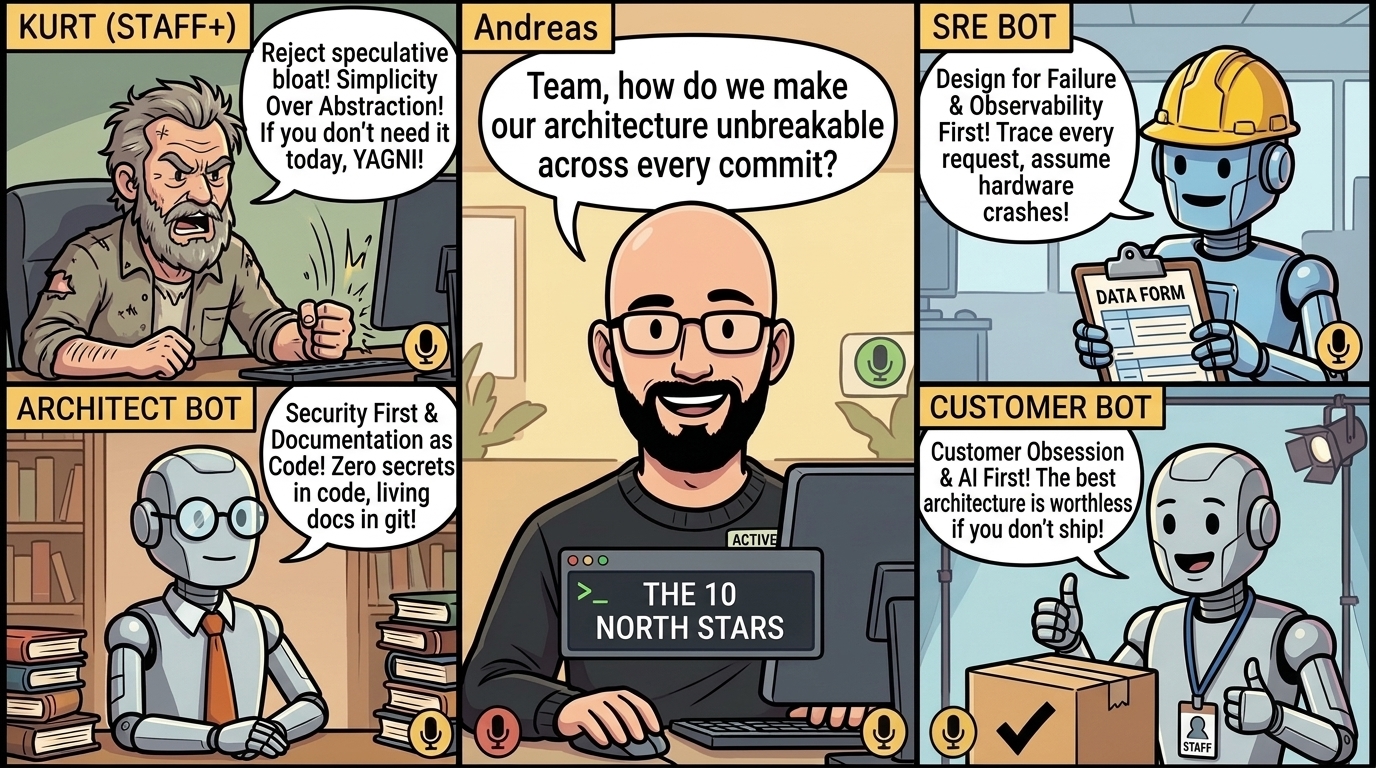
Comic strip transcript — Andreas: "Team, how do we make our architecture unbreakable across every commit?" Kurt (Staff+ Engineer): "Reject speculative bloat! Simplicity Over Abstraction! If you don't need it today, YAGNI!" SRE Bot: "Design for Failure & Observability First! Trace every request, assume hardware crashes!" Architect Bot: "Security First & Documentation as Code! Zero secrets in code, living docs in git!" Customer Bot: "Customer Obsession & AI First! The best architecture is worthless if you don't ship!"
“A principle isn’t a principle until it costs you something or tells you what not to build.”
Every engineering team has a Wiki page or an onboarding slide deck titled “Our Engineering Principles”.
You know the ones:
- “We write clean code.”
- “We move fast without breaking things.”
- “Security is everybody’s responsibility.”
They sound virtuous in an all-hands meeting. But the moment production hits a 2 AM Sev-1 outage, or a tight deadline looms on Friday afternoon, those corporate mantras vanish like smoke.
Junior developers take shortcuts because they lack guidance. Senior engineers argue in circular pull-request threads for two weeks over cosmetic abstractions. And management wonders why technical debt keeps compounding while delivery velocity grinds to a halt.
Earlier this year, when I established my autonomous engineering workflow with my AI Squad, we recognized an uncomfortable truth:
If your engineering principles don’t have teeth in your compiler, your test harnesses, your CI/CD pipelines, and your AI agent system prompts, they aren’t architecture. They are decorative wallpaper.
We didn’t want vague slogans. We needed an unshakable, non-negotiable architectural compass.
We created the 10 Engineering North Stars.
(Why ten? Why not fifteen or twenty? Because if you have twenty priorities, you have none. A sprawling checklist of thirty rules is just another unmaintainable slide deck that gets abandoned the moment production catches fire. Ten is deliberate: tight enough for an engineer—or an autonomous agent—to keep front-of-mind, comprehensive enough to govern our entire architectural surface area, and intentionally constrained so we can actually sustain and enforce it across every single commit).
The Compass: The 10 Engineering North Stars
Each North Star is documented, measured, and tracked in our public North Stars Portal. Whenever we review an Architecture Decision Record (ADR), propose a refactor, or prompt an AI agent, we explicitly cite which North Star governs the decision.
Here is the compass:
I. AI First (ai-first)
“Amplify human capabilities with AI.”
We do not treat AI as an afterthought or an occasional autocomplete gadget. We design systems from day one so that autonomous agents, LLMs, and MCP tools can read, test, simulate, and debug the code without friction. If an API requires manual mouse-clicks or returns unstructured ANSI garbage that breaks an agent’s parser, it fails this North Star.
II. Security First (security-first)
“All systems must be secure by default.”
Security is never bolted on at the end of a sprint. Zero Trust, TPM 2.0 PCR sealing, YubiKey SSH credentials, encrypted backups, least-privilege RBAC, and automated DNSSEC/DMARC audits are mandatory baselines. If a feature works but violates least-privilege, it doesn’t ship. Period.
III. Automation Over Manual (automation-over-manual)
“Prefer automation over manual steps.”
If a human has to execute a command twice, write a script. If they have to execute it three times, automate it into a CI/CD pipeline or an Ansible playbook. Manual workstation setups, snowflake VPS configurations, and ad-hoc deployment clicks are architectural antipatterns.
IV. Documentation as Code (documentation-as-code)
“Documentation is a living production asset.”
Wikis, external docs, and unversioned Google Docs are where institutional knowledge goes to die. We treat ADRs, runbooks, and Open Knowledge Format (OKF) markdown documents as production code. They live in version control alongside the source, undergo peer review, and get indexed directly into our agents’ local vector stores.
V. Design for Failure (design-for-failure)
“Champion a blameless culture where systems fail safely.”
Hardware crashes. Networks partition. Upstream APIs rate-limit. Third-party cloud regions go dark. We design systems assuming every component will eventually fail. Automated Restic snapshots, offsite storage replication, self-healing container healthchecks, and blameless post-mortems turn catastrophic downtime into non-events.
VI. Observability First (observability-first)
“Systems must be observable from day one.”
You cannot fix what you cannot see. OpenTelemetry traceparent propagation, Prometheus metric scrapers, structured JSON logging with zero PII, and continuous profiling are day-one requirements—not post-launch hotfixes.
VII. Data Sovereignty (data-sovereignty)
“Prioritize absolute data control.”
Never become a hostage to proprietary cloud silos or surveillance pricing. We self-host our critical vector databases, maintain offline-capable GGUF models on local silicon, run sovereign EU hosting (Hetzner, Inleed, Statichost), and verify that our intellectual property never leaks into third-party training pipelines.
VIII. Cost Efficiency (cost-efficiency)
“Architecture must make economic sense.”
Cool tech that bankrupts your budget is bad engineering. We measure Total Cost of Ownership (TCO) relentlessly: lean VPS sizing, Native AOT distroless container binaries, and local token-efficient tools that bypass expensive cloud API calls. If a 10-line bash script solves what a $5,000/month enterprise SaaS tool does, we write the script.
IX. Simplicity Over Abstraction (simplicity-over-abstraction)
“Reject speculative complexity.”
KISS (Keep It Simple, Stupid) and YAGNI (You Aren’t Gonna Need It) are not suggestions; they are survivability traits. We brutally prune dead code, avoid Rube Goldberg architectural wrappers, and refuse to build abstractions for hypothetical future problems. Linear, explicit code beats clever abstractions every single time.
X. Customer Obsession (Shipping is a Feature) (customer-obsession)
“The most elegant architecture is worthless if it doesn’t solve a real user’s problem.”
Theoretical perfection is the enemy of actual utility. We test our software against real user personas, build frictionless one-command installation curl scripts, and optimize for day-one time-to-value. Shipping working software to real users trumps endless architectural debate.
How Principles Gain Teeth in the Real World
Principles that only live on a poster on the office wall are useless. In our daily workflow, the 10 North Stars have concrete mechanical enforcement:
-
System Prompt Injection: Every AI persona in my squad—from Kurt (the savage Staff+ reviewer) to the SRE Bot—has the North Stars embedded in their prompt rules. When an agent reviews a pull request or writes an implementation plan, it must explicitly cite which North Star governs each trade-off.
-
Automated Static Analysis & CI Linting: Our pipeline linters enforce rules tied directly to North Stars. If a pipeline step hardcodes manual credentials, it fails on
[II. Security First]. If an Azure DevOps template duplicates nested abstractions, our custom linter flags[IX. Simplicity Over Abstraction]. -
Public Cross-Linking in Every Post & Project: Every technical case study on
ainytta.blogtags its governing North Stars in its YAML frontmatter. Readers and autonomous crawlers can visit our North Stars Hub to explore the foundational principles guiding each published architecture.Work in Progress: Granular bidirectional cross-linking—connecting every commit, personal project codebase, and empirical metric directly to individual North Stars—is an upcoming feature actively being refined behind our
northStarsRelatedfeature flag. The portal currently serves as our core architectural compass, with live project linkages rolling out iteratively.
Conclusion: Finding Your North
In an industry saturated with hype cycles, ephemeral frameworks, and skyrocketing API bills, you don’t need more noise. You need clarity.
Having an explicit set of North Stars doesn’t make engineering easy. But it does make decisions fast, consistent, and honest.
When you’re faced with an architectural fork in the road, don’t ask what’s trendiest on Hacker News. Look at your compass.
Check out our full live tracking across all 10 principles on the Engineering North Stars Portal.
— Andreas, Staff Architect
